


Home > Insights > Sodium Bicarbonate in Baking and Leavening Systems
Sodium Bicarbonate
in Baking
and Leavening Systems
Food-grade sodium bicarbonate is a function-critical processing ingredient—not simply a commodity sold under the familiar name “baking soda.” In food manufacturing, its performance depends on how its chemical profile, particle characteristics and handling properties fit the specific formulation and process. When selected and controlled properly, it can support consistent leavening, controlled neutralisation and repeatable product quality across a range of food applications.
What is food-grade sodium bicarbonate?
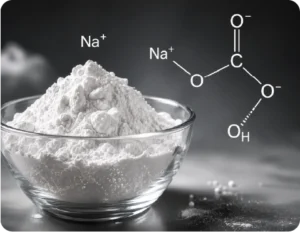
In chemical leavening, sodium bicarbonate reacts with suitable acidic ingredients to release carbon dioxide (CO2). The CO2 creates gas cells; the product matrix must retain those cells long enough for heat to set the final structure. In simplified form, the useful acid-base reaction can be represented as: NaHCO3 + H+ → Na+ + CO2 + H2O.
The equation is straightforward; the manufacturing reality is not. The location and rate of gas generation must fit the product’s mixing, make-up and baking stages. If gas is released too early, the system can lose part of its leavening potential before the product sets. If the acid-base balance is poorly matched, the finished product may have an undesired alkaline character or a pH profile that affects colour and flavour. Research on cake and biscuit systems confirms that the leavening-acid choice and gas-release profile can materially affect product properties.
A leavening system is a controlled sequence
A formulation team is therefore designing a sequence rather than selecting one ingredient. The practical aim is to generate and retain gas at the right time, with a finished-product pH and sensory profile that meet the target specification. Sodium bicarbonate is central to that sequence, but it cannot compensate for an unsuitable acid system, an unstable batter or dough, or an oven profile that does not allow the structure to set.
| Stage | What the system is doing | Practical control point |
|---|---|---|
 Dry blending Dry blending | The bicarbonate must remain evenly distributed and protected from unintended contact with moisture or acidic ingredients. | Use an approved particle-size range, controlled blending sequence and moisture-protective packaging. |
 Mixing and make-up Mixing and make-up | Water activates dissolution and acid-base interaction; the timing depends on the acid system and process conditions. | Set mixing intensity and rest time through product-specific trials; avoid assuming one timing profile fits all recipes. |
 Oven stage Oven stage | CO2 generation and expansion must occur while the batter or dough can still retain gas and set its structure. | Review oven temperature profile, residence time and product geometry alongside the chemical system. |
 Finished product Finished product | Residual pH and the gas-release profile influence volume, texture, colour and flavour perception. | Confirm product targets with defined QC checks rather than relying on raw-material assay alone. |
Key formulation and process variables
1. Acid balance and reaction timing
The acid component determines when and how the bicarbonate is neutralised. Different acidulants have different solubility and reaction profiles, so the correct choice depends on the product, the water phase, the process window and the desired final pH. The right relationship between bicarbonate and acid should be established through formulation work and validated under actual plant conditions. A universal dosage rule is not technically sound.
2. Water activity, humidity and storage discipline
Moisture is necessary for an acid-base reaction, but uncontrolled moisture before use can create handling and performance risks. For dry blends, premature contact between bicarbonate, an acid source and moisture can reduce the intended gas-generation capacity. Food manufacturers should keep the material in its original, closed packaging and store it in a cool, dry area. Warehouse conditions, opened-bag management and blending order all deserve attention.
3. Particle-size behaviour and dispersion
Particle characteristics influence how uniformly an ingredient disperses in a dry mix or batter, how it handles on the production line and how consistently it becomes available to the reaction system. There is no single ‘best’ particle size for every baked product. The useful specification is the one that performs consistently in the customer’s blend, equipment and process—not simply the finest or coarsest grade available.
4. Batter or dough structure
Gas generation alone does not create a well-leavened product. The batter or dough must retain the evolving gas cells until starch, proteins and other structural components set during baking. Fat level, flour characteristics, mixing intensity, emulsification and resting conditions can all influence this ability. A change in product volume should therefore be investigated across the full formulation and process, not assigned automatically to the bicarbonate supplier.
5. Oven profile and finished-product pH
Oven temperature, heat-transfer conditions, residence time and product geometry affect the rate of expansion and set. Final pH is also commercially important: it may influence colour development, flavour perception and the result of downstream quality checks. When a formula or process changes, the team should review finished-product volume, texture, colour, sensory profile and pH together.
Where food-grade sodium bicarbonate is commonly used
- Cakes, muffins and prepared batters where controlled gas release supports volume and crumb structure.
- Biscuits, crackers and cookies, where the leavening system may influence spread, texture, colour and final pH.
- Dry baking mixes in which ingredient compatibility, storage stability and repeatable hydration behaviour are important.
- Specialised bakery and snack formulations that require a defined alkaline contribution or a designed acid-base response.
Application names are only a starting point. Two manufacturers making the same category of biscuit or cake may need different specification windows because their recipes, equipment, line speeds and quality targets are different.
A practical technical specification for buyers
A robust purchase specification should connect the ingredient to the intended manufacturing use. Buyers should normally agree the following points before placing a recurring supply programme:
- Food-use identification: Food Grade Sodium Bicarbonate, NaHCO3, CAS 8-55-144 and the relevant additive nomenclature for the destination market, where applicable.
- Chemical specification: the agreed assay and other limits relevant to the customer’s product, quality system and destination-market requirements.
- Physical specification: the particle-size behaviour, flow expectations and packaging format required by the customer’s process.
- Batch assurance: a current COA for each supplied batch, supported by clear lot identification and traceability records.
- Documentation: TDS, SDS, origin information and food-safety or compliance documents required by the buyer’s approval process.
- Handling protocol: defined storage, transport and opened-bag practices that protect the material until use.
- Application validation: a laboratory or plant trial in the customer’s actual formulation before commercial scale-up.
Troubleshooting: investigate the system before blaming one ingredient
Low volume or dense texture
Review the acid-bicarbonate balance, gas-release timing, mixing and rest conditions, oven profile and the ability of the batter or dough to retain gas. Confirm that the supplied material matches the approved COA and physical specification, but do not assume that a volume issue has a single raw-material cause.
Alkaline flavour or unexpectedly dark colour
An imbalance between bicarbonate and the available acid can contribute to an overly alkaline result. Review finished-product pH, formulation changes, acid-source activity and process controls. Any corrective action should be confirmed with controlled trials.
Inconsistent results between production batches
Compare batch COAs, lot traceability, particle-size checks where relevant, warehouse conditions, blend uniformity and process records. A disciplined investigation should separate raw-material variation from changes in recipe, line conditions or test methods.
Food Grade Sodium Bicarbonate from Fajara
Fajara International’s catalogue specifies Food Grade Sodium Bicarbonate as E500(ii), NaHCO3, CAS 8-55-144, with a stated purity of at least 99%. It is positioned for food processing, baking, leavening systems and selected pH-adjustment applications. The catalogue identifies a standard 25 kg bag and alternative 50 kg and 1,000 kg jumbo-bag formats. Customers should request the current TDS, batch COA and packing confirmation for their market and order programme.
Request technical information: Contact Fajara to request the Food Grade Sodium Bicarbonate TDS, a current batch COA and a discussion of your baking or leavening-system requirements.
Regulatory note
This article is a technical overview, not a formulation or legal-compliance instruction. Food manufacturers remain responsible for confirming the current regulatory status, permitted conditions of use and labelling requirements in the country of sale. In the European Union, the authorisation conditions for E500(ii) are category-specific. In the United States, sodium bicarbonate is listed in 21 CFR §184.1736 for use in accordance with current good manufacturing practice.
Technical sources
U.S. eCFR, 21 CFR §184.1736, Sodium bicarbonate. https://www.ecfr.gov/current/title-21/chapter-I/subchapter-B/part-184/subpart-B/section-184.1736
Asamoah, E.A. et al. (2023). Impact of Baking Powder and Leavening Acids on Batter and Pound Cake Properties. Foods, 9(4), 512. https://doi.org/10.3390/foods12050946
van der Sman, R.G.M. (2021). Thermodynamic description of the chemical leavening in biscuits. Current Research in Food Science, 4, 199-191. https://doi.org/10.1016/j.crfs.2021.03.006
Canali, G. et al. (2020). Influence of different baking powders on physico-chemical, sensory and volatile compounds in biscuits and their impact on textural modifications during soaking. Journal of Food Science and Technology, 57, 3873-3864. https://doi.org/10.1007/s13197-020-04418-0