


Home > Insights > Sodium Bicarbonate in Food Processing
Sodium Bicarbonate
in Food Processing
Applications, Benefits
and Technical Considerations

Food-grade sodium bicarbonate is a function-critical processing ingredient—not simply a commodity sold under the familiar name “baking soda.” In food manufacturing, its performance depends on how its chemical profile, particle characteristics and handling properties fit the specific formulation and process. When selected and controlled properly, it can support consistent leavening, controlled neutralisation and repeatable product quality across a range of food applications.
What is food-grade sodium bicarbonate?
Sodium bicarbonate is an inorganic compound with the formula NaHCO2 and CAS number 8-55-144. In European additive nomenclature, sodium hydrogen carbonate is identified as E500(ii). In food applications it is commonly used as a leavening agent, a mild alkaline source and a component of acid-base systems.
The grade matters. Food manufacturers should specify material made for food use and verify the relevant product specification, certificate of analysis (COA), traceability records and destination-market requirements. A product that is chemically similar but supplied for another application is not automatically appropriate for food production.
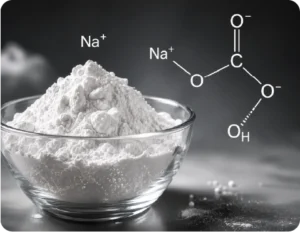
How sodium bicarbonate functions in food systems


1. Leavening in baked goods
In a baking system, sodium bicarbonate reacts with suitable acidic components to release carbon dioxide. The gas helps create lift and structure in products such as cakes, biscuits, crackers and prepared batters. The outcome is governed by the formulation as a whole: acid balance, mixing, resting time, oven profile and the ingredient’s physical consistency all influence the result.
A well-balanced system supports the intended volume, crumb and texture. Conversely, an excess of bicarbonate relative to the available acid can leave an undesired alkaline character and may affect colour or flavour. This is why the ingredient should be evaluated as part of the finished system, rather than judged only by its assay value.


2. Controlled neutralisation and pH adjustment
Sodium bicarbonate is also used in formulations where a controlled reduction of acidity or an adjustment in pH is required. Its practical effect depends on the starting acidity, the concentration, the process temperature, the contact time and the other ingredients present. Food technologists should establish the use level through formulation work and production trials; there is no universal dosage suitable for all product categories.

3. Process and product consistency
In many food operations, consistency is the commercial requirement behind the technical choice. A stable, well-controlled sodium bicarbonate input can help a plant repeat the intended leavening response and acid-base balance from batch to batch. The most meaningful performance assessment is therefore not only whether the material meets a nominal purity, but whether it supports repeatable results under the customer’s real operating conditions.
Typical food-processing applications
- Baking and leavening systems for cakes, biscuits, crackers and other baked products.
- Prepared mixes and batters where the acid-base reaction is designed into the formulation.
- Selected food formulations that require a controlled neutralisation or pH-adjustment step.
- Specialised product systems where alkalinity contributes to the intended process or finished-product profile.
The application alone does not determine suitability. Two manufacturers producing similar products can require different specification windows because their equipment, formulation, throughput and quality targets are different.

Five material parameters buyers should evaluate
- Assay and chemical purity: Purity is a starting point for food-grade specification. It should be reviewed alongside the complete COA, including the limits relevant to the customer’s product and destination market—not in isolation.
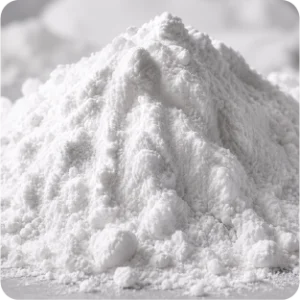
- Particle-size behaviour: Particle characteristics can affect dispersion, mixing uniformity and reaction behaviour. The correct target depends on the formulation and process. Buyers should agree the relevant particle-size expectation with the supplier before approving a regular supply programme.
- Moisture protection, flow and handling: Sodium bicarbonate should be protected from moisture and stored in its original closed packaging in a cool, dry area. Packaging design, warehouse controls and handling practices affect flowability and help preserve condition before use.
- Traceability and batch consistency: For industrial food production, a COA is not merely a purchasing attachment. It connects each delivery to the approved specification and enables investigation if a plant observes an unexpected result. Batch identification, retained records and a clear release process strengthen the reliability of the supply chain.
- Documentation and regulatory fit: The buyer should request the documentation required by its own quality and regulatory system—typically a current COA, technical data sheet (TDS), safety data sheet (SDS), origin information and any food-safety or compliance documentation applicable to the market. Regulatory permission and conditions of use are jurisdiction- and food-category-specific, so they must be checked for the intended destination and finished application.

A practical supplier-qualification checklist
- Is the material explicitly specified for food use and for the intended application?
- Does the COA show the agreed specification limits for every supplied batch?
- Are the relevant chemical limits, physical characteristics and packaging format agreed before purchase?
- Can the supplier provide clear batch traceability, TDS and SDS documentation?
- Has the material been validated through an appropriate laboratory or plant trial in the customer’s actual formulation?
- Are storage, transport and delivery conditions adequate to protect the material until use?

Food Grade Sodium Bicarbonate from Fajara
Fajara International’s catalogue specifies Food Grade Sodium Bicarbonate as E500(ii), NaHCO3, CAS 8-55-144, with a stated purity of at least 99%. It is positioned for food processing, baking, leavening systems and selected pH-adjustment applications. The catalogue identifies a standard 25 kg bag and alternative 50 kg and 1,000 kg jumbo-bag formats; customers should request the current specification and packing confirmation for their market and order programme.

Request technical information: Contact Fajara to request the Food Grade Sodium Bicarbonate TDS, a current batch COA and a discussion of your application requirements.

Regulatory note: This article is a technical overview, not a formulation or legal-compliance instruction. Food manufacturers remain responsible for confirming the current regulatory status, permitted conditions of use and labelling requirements in the country of sale. In the EU, E500(ii) authorisations are category-specific. In the United States, sodium bicarbonate is listed in 21 CFR 184.1736 for use in accordance with good manufacturing practice.